Red Fox
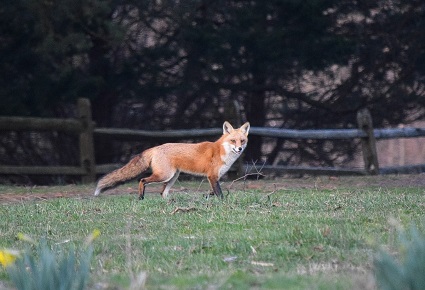
Foxes are one of the many animals that call our parks home. This red fox was spotted at
Huber Woods Park, Locust, likely looking for a morning meal. Their omnivorous diet changes based on what is available, generally consisting of a mix of fruits, nuts, insects, rodents, rabbits and birds. This makes them ecologically important as not only a dispersant agent for many plants, but to also help control the rodent population. It’s always a special treat seeing them in the parks, but please remember to keep your distance when viewing wildlife, as to not disturb or cause potential harm to them. (posted 4/8/2024)
Gray Seal

Recently, a juvenile male grey seal was found resting at the
Bayshore Waterfront Park, Port Monmouth. It is not unusual to find seals resting on beaches along the Jersey Shore during the winter and early spring. After a busy night of foraging and feeding in local waters, a seal will often haul out of the water to rest and digest its food. Seals do not chew food but take large bites and swallow in pieces their food, such as fish, sand eels, and squid. If a seal is unable to properly digest its food, it could get sick and even die. If you find a seal on a beach, please stay at least 150 feet away and leave the seal alone to rest and digest its meal from the night before. Please notify park rangers of any seal sighting so we may safeguard the wild animal from human disturbance and to contact the proper authorities if the animal appears sick or distressed. (Posted 3/21/2024)
Osage Orange


What might look like a dog’s old chew toy is actually the fruit of an Osage orange (Maclura pomifera). The bright yellow-green softball sized fruit, sometimes called a horse or hedge apple, is neither an orange nor an apple. They are more closely related to mulberries and their seeds are only eaten by few animals such as the squirrel. It is believed that Osage oranges are an anachronistic fruit, meaning they belong to an earlier time. Researchers theorize that their large size made them ideal for mammoths and ground sloths to eat and disperse the seeds.
Today the Osage orange tree is popularly used for its wood, which was first utilized by the Indigenous peoples. They would manipulate its branches to make their bows because of its flexibility, rot resistance, and strength. It is still considered one of the best woods to use for bows and is commonly purchased for fence making. It is also great for burning, having one of the highest BTU ratings of any common wood in North America.
The pictured Osage orange fruit was found along the
Bayshore Waterfront Park, Port Monmouth. The fruit normally falls from the tree in autumn, but as you can see in the second picture, there is one last fruit holding on as we enter spring! (posted 3/20/2024)
Coverboards

Pictured - (l to r) Park System Naturalist Heather FitzGerald and Ecologist Maggie Wasacz with newly placed coverboard.
You can’t protect what you don’t know about! Which is why Park System Ecologists and Naturalists are working with NJ Fish and Wildlife biologists and local university scientists to conduct herp (amphibians and reptiles) research in our parks.
Effectively studying and tracking the population of salamanders, smaller snakes, and many turtle species in a given location can be very challenging. However, this information is critical when devising a management strategy. Conducting absence-prescience (A-P) studies is a way to gather this information, and a popular method in herp research is to use coverboards.
Many salamanders and small snakes hide under rotting logs, but they are equally happy to use discarded metal or other garbage - which is where coverboards come in. Materials and designs vary but coverboards, like the one pictured above, are placed in the environment and mimic logs. Just like logs, they attract these animals but provide a sustainable, portable and trackable way to study their population as scientists return to monitor them.
This research is just one of the many ways the Park System works to protect local habitat and native wildlife. (posted 3/8/2024)
Amphibious Amphitheaters
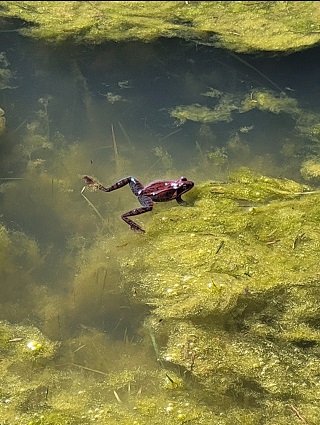
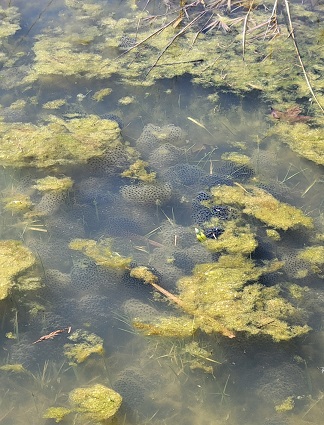
With the recent combination of snowmelt and rainfall, soils across the county have been saturated to the point where vernal pools have formed everywhere. These temporary aquatic environments create the perfect breeding site for numerous species of native frogs and salamanders.
A visit to one of the vernal pools in Dorbrook Recreation Area, Colts Neck, will introduce you to a cacophony of frog calls. Spring Peepers and Wood Frogs can be heard here calling by the hundreds. These amphibians call out to other members of their species for mating purposes. (Click on the sound file above to hear.) Once the ritual is complete, gelatinous clusters of eggs can be found in the pools. In roughly two weeks, the eggs will hatch into tadpoles, which will feed on surrounding algae, plant detritus, and the occasional microorganism.
Have fun exploring our parks this time of year and listen for these wonderful natural phenomena. (posted 3/4/2024)
Bald Eagles Nesting
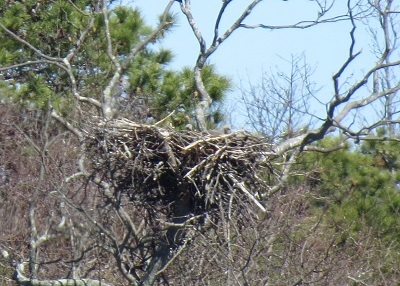
Photo reposted from 2017.
We are very happy to announce that the resident Bald Eagle pair at the
Manasquan Reservoir, Howell, began incubation on February 26. This is our latest start date for a nest recorded here at the Manasquan Reservoir. Naturalists observed the female sitting low in the nest and remaining there. From now on, one of the adults will almost always be seen in the nest. The female eagle begins sitting immediately upon producing her first egg. She may lay up to three eggs over five to six days. The male assists with incubation by giving the female breaks. He also brings food to the female and helps protect the nest. If everything goes well, we expect hatching to occur the last week of March. They are nesting in the same nest as the last few years.
Reminder: Nesting Bald Eagles are very sensitive to disturbance by humans. Approaching a nest by land or water could cause them to abandon their eggs or young. Do not approach the nest or enter any protected areas. The nest can be viewed safely from the trail adjacent to Georgia Tavern Road or from inside the Manasquan Reservoir Environmental Center via a live television monitor.
Sapwells
Sometimes, we may not see the inhabitants of our local ecosystems, but instead find evidence they have left behind. Tracks, bones, fur and feathers are just some of the signs that tell us what animal might be nearby. Pictured above are neat rows of little holes called sapsuckers that have been drilled by a particular species of woodpecker - the Yellow-bellied Sapsucker, Sphyrapicus varius.
After drilling the holes, the woodpecker laps up the sap that oozes from these well-manicured crannies. They will even ingest any insects trapped by this sweet treat.
A common species of woodpecker, Yellow-bellied Sapsuckers can be seen throughout many of our parks. Both the male and female are distinguished by their mostly black and white plumage and red cap atop their head. In comparison to other frequently seen woodpeckers, they are larger than a Downy Woodpecker but slightly smaller than a Hairy Woodpecker. (posted 2/26/2024)
Winter is a wonderful time of the year to visit any of your Monmouth County parks, especially if you are interested in enjoying the changing scenery. A recent snowy morning had one of our Park System Naturalist taking in the sights at Perrinville Lake Park, Millstone, and the Manasquan Reservoir, Howell. At Perrineville Lake Park, fresh snow covered fields and trails without even a hint of human footprints, and the lake was extra picturesque as flurries drop onto the water.
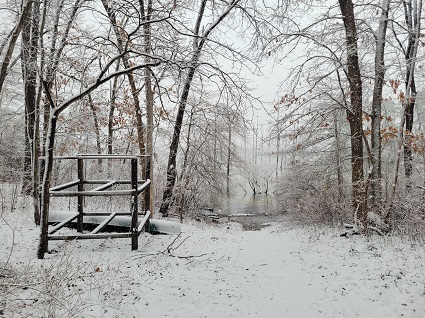
Even the Manasquan Reservoir felt a little extra enchanting as fresh snow clung to branches and covered trails. (posted 2/16/2024)
Photography Exhibit
Feeling the winter blues and looking for an excuse to get out of the house on a cold dreary day? Head over to the Manasquan Reservoir Environmental Center, Howell, and check out the 2023 “Shapes of Nature” Photography Contest Exhibit! On display through the end of February 2024, this exhibit is a great way to review the past year through beautiful photographs submitted by our local community members. The contest had two divisions: Adult and Children; and two categories: General Photography and Wildlife Photography. Let the colors of nature guide you through the four seasons as you peruse the building.
While there, be sure to check out our displays including live native animals, crawl through our muskrat lodge, and view the eagle cam. Whether you’re by yourself or with the whole family, there’s plenty to see and do. (posted 2/1/2024)
Winter Visitors
Winter is an exciting time for birders as they bundle up and brave cold temperatures in the hope of spotting rare visitors. So far, this winter's highlights include some exciting ducks and geese at Thompson Park, Lincroft. The park’s fields draw large flocks of Canada Geese that offer the opportunity to play “Where’s Waldo?” as birders look for an odd-ball goose among thousands. Although challenging, it can be very rewarding. A Pink-footed goose, a Greater White-fronted goose, a snow goose, and a cackling goose have all been spotted this way.
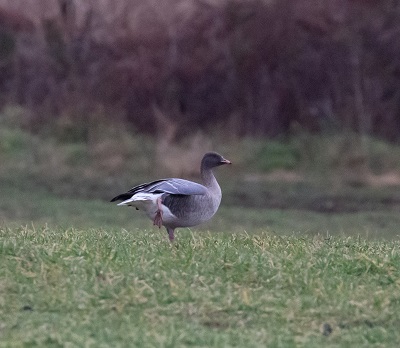
Pink-footed goose
Among the Canada Geese, the Pink-footed goose stands out with its pink bill, brown neck, bright pink feet, and smaller size.
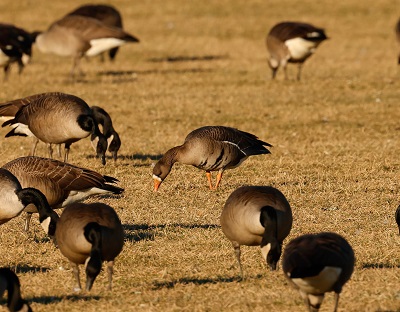
Greater White-fronted Goose
The Greater White-fronted goose is also smaller and can by identified by its orange bill, white patch on its face, brown neck, black barring on its chest, and bright orange feet.
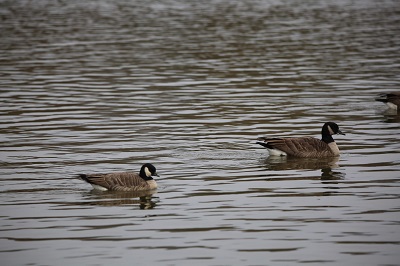
Cackling Goose
While the Cackling goose has similar coloration as the Canada goose, it is tiny in comparison and has a smaller head, shorter neck, and tiny bill. The most seen subspecies of cackling geese, the Richardson’s subspecies have a white base at the bottom of the black on their necks.
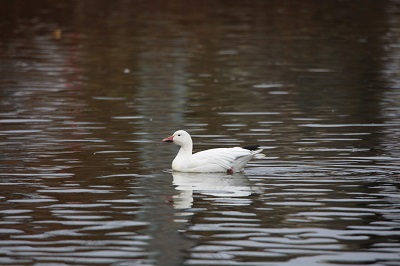
Snow Goose
The Snow Goose is striking with its overall white coloration, orangey stout bill with a grin patch, and black wingtips that are visible even when they are at rest. (posted 2/1/2024)
Recently a Black Guillemot was spotted just off the coast of Monmouth County along one of our many rock jetties. These birds are a part of the Auk family, along with Razorbills, Dovekie and Atlantic Puffins. They are all rare winter visitors found along the coast, usually staying off shore which makes sightings hard to come by from land.
This bird is in its non-breeding plumage with its white head and underparts, but during breeding season it will be all black with a white-wing patch and bright reddish legs. They are great divers that like to eat fish and small invertebrates like crabs, worms and mollusks, and the habitat they prefer is along rocky shorelines. They breed up along the cliffs in Maine and north into the Canadian Arctic and even as far away as Alaska. A great Monmouth County park to spot winter Auks and winter ducks is
Seven Presidents Oceanfront Park, Long Branch, especially around the rock jetties and outflow pipes. Just remember to always keep your distance from wildlife so as not to disturb or cause potential harm to them. (posted 1/31/2024)
What’s That Track?
Looking for animal tracks is always a fun thing to do when walking in our parks. These tracks were left behind in the snow at Freneau Wood Park, Aberdeen. They’re an indicator that wildlife is present, but what kind of animal is this? If you guessed raccoon, you are correct! Their front feet are hand-shaped with five finger-like toes that resemble tiny human handprints. The hind feet are very similar but have elongated heels because raccoons carry most of their weight on their back ends.
Other than the species of the animal, we can also guess that this raccoon might have been foraging for food by the pattern of the prints. Raccoons have unique gaits that they use when looking for food and walking slowly when not in the presence of danger.
Looking at the above pictures, you can see that each set of prints consists of a small and a slightly larger print next to each other. This is usually because their left hind foot is placed next to the right forefoot, almost looking like they’ve hopped. Step lengths can also vary, creating a one-foot-in-front-of-the-other design. When running, they may leave more of a gallop pattern where the front feet land together before the hind feet land together. (posted 1/25/2024)
Squirrel
National Squirrel Appreciation Day is January 21! There are four species of squirrel in New Jersey: the Eastern Gray Squirrel (pictured above), the American Red Squirrel, the Northern Flying Squirrel, and the Southern Flying Squirrel. They are remarkedly hardy creatures because of their small size, short breeding cycle, and ability to eat a wide variety of foods. Their bodies are covered in short, thick hair and their long, bushy tail is used to balance themselves as they leap from tree to tree. It is said that a squirrel can leap across a space 10 times the length of their body!
As shown in this image, all these rodents share an ability to camouflage from predators. The darker coloration on top aids in hiding them from predators above like hawks, owls, and eagles; while their white belly blends in with the brightness of the sky (or snow for this time of year!) and hides them from predators of the forest floor like red fox, bobcats and coyotes.
Eastern Gray Squirrel is so common to see that their most beneficial behavior often goes unnoticed because we see them as a nuisance/pest. Most of us already know about squirrels hiding acorns before the cold temperatures of winter but, we forget how important that is for forest renewal. Many of the nuts and acorns cannot be found after they have been dug, which means that squirrels are actually “nature’s gardeners” planting seeds and aiding in the growth new trees! (posted 1/18/2024)
Reindeer Lichen
Reindeer Lichen (Cladonia rangiferina) is a light-colored, fruiticose, cup lichen in the family Cladoniaceae. Like other lichen species, they are composed of a fungus and an algae living together in a symbiotic, or mutually beneficial relationship. Unlike mosses, lichen do not have any roots, stems or leaves and their chloroplasts are contained only in the algae on the top surface of the lichen. This species grows in both hot and cold climates in well-drained, open environments. Reindeer lichen can be found in the Arctic tundra, Canadian boreal forests, and spread throughout the northeastern United States. As the common name suggests, it is an important food for reindeer (caribou) and is economically important as a result. (posted 12/13/2023)
Birding Expedition Highlights
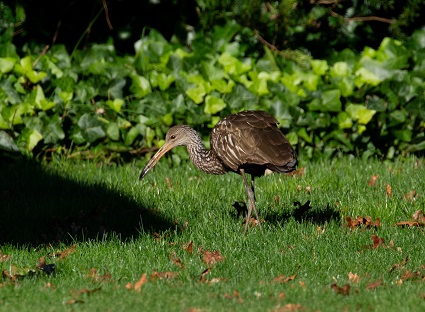
Limpkin
On a recent Fall Birding Expedition, a monthly
all-day bus trip run by the Park System that searches for birds around the
state, we had some incredible luck. We
started our morning in Monmouth County and found a Limpkin. It was the first
record for this species in the state.
Limpkins prefer tropical wetlands habitats. They are usually found in the
United States only in Florida and part of Georgia. Outside of the United States, they are found
in Central and South America. We unexpectedly
found our Limpkin feeding on invertebrates in the grass of a local park in Wall
Township. In recent years, it is thought
that the introduction of an invasive apple snail in the United States has
allowed Limpkins to become an extra vagrant species as this new food source has
become available. In fact, they have been found in 26 states and two Canadian provinces. Although in appearance Limpkins resemble
Ibis, herons, and egrets; they are more closely related to rails and
cranes. They have a long neck, a long
and heavy yellowish bill, white spotting on their back and sides, and overall
brown color. These long-legged birds are
easily identified when found in marshes and swampy forests.
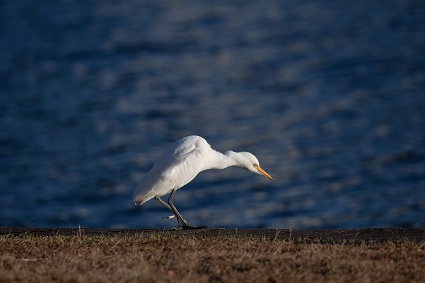
Cattle Egret
We found our second rarity of the day while still in
Monmouth County. This time it was a Cattle
Egret that was hiding along the small marsh found at the National Guard Training
Center in Sea Girt. The Cattle Egret is
a small, compact, stocky white egret with yellow bill. With its non-breeding
plumage, it has all black legs and feet and prefers upland habitat. It
resembles the more common Snowy Egret, which is also white but has a black
bill, black legs, and golden colored feet; and likes wetland habitats. They are typically found further south and occasionally
spotted during migration as they sometimes tend to wander.
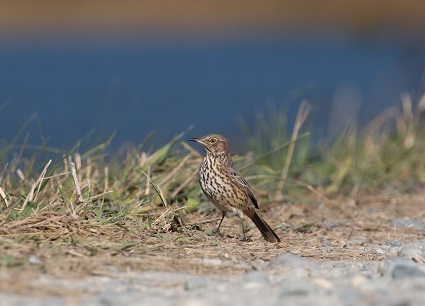
Sage Thrasher
Our third highlight of the day was found along the Wildlife
Drive at the Edwin B. Forsythe Wildlife Refuge in Atlantic County. We encountered a Sage Thrasher - a bird
usually found on the West Coast of the United States. This is only the fifth record for this bird
species in New Jersey. Thankfully with a
little patience and luck, the bird was very obliging and came out along the
grasses and gave us some close views and photo opportunities. Sage Thrashers
are the smallest of the thrasher species found in the United States. It has a short bill, a heavily streaked breast,
a greyish-brown back, two thin white wing bars, and pale eyes. They are usually found standing erect on the
ground or on a short perch in sagebrush habitats.
Other highlights of this fantastic trip include a
Rough-legged Hawk and a Short-eared Owl that was hunting over a marsh as we
stood on a small boardwalk perch. Throughout
the day, we saw and heard 89 species - including some incredible rare birds – that
made for a memorable outing. Visit our Programs & Registration page and search "birding" for our upcoming birding trips and walks. (posted 12/23/2023)
Sun Halo
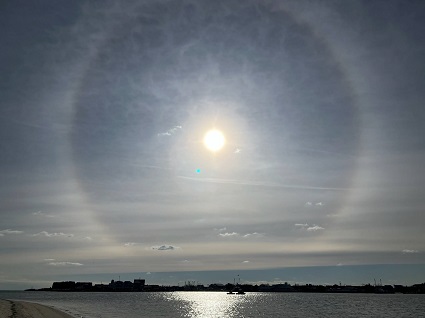
Photo courtesy of Neal Fitzsimmons
On a recent Casual Birder walk, we visited Fisherman's Cove Conservation Area and were given the added bonus of not only finding interesting bird species but an extra interesting meteorological phenomenon of seeing a sun halo formed in the sky as we walked along the shoreline.
The optical effect that causes a sun halo is quite rare, but it can happen when ice crystals form in the sky and refract, acting like a prism breaking visible light into its color components. According to the National Oceanic and Atmospheric Administration (NOAA), a halo is a ring or light that forms around the sun or moon as the sun or moon light refracts off ice crystals present in a thin veil of cirrus clouds. The halo is usually seen as a bright, white ring although sometimes it can have color. (posted 12/12/2023)
White-faced Ibis
While you may be tempted to stay indoors during the cold weather, there are plenty of reasons to head out into the field this winter! Recently, a juvenile White-faced Ibis was found at the Manasquan Reservoir along the shoreline close to the Environmental Center. It was seen feeding in the shallows, where ice had started to creep in along the edge. While the more common and expected species to find in Monmouth County is the Glossy Ibis; fall is a good season for rarities showing up. The features that helped us identify the White-faced Ibis were its reddish colored legs, overall pale brown color, paler cheeks, grey bill, and red-based dark eye color. We also heard its higher pitched calls in the field. (posted 12/12/2023)